Show 41
Was Sein Kann
Klaus Merkel | Curio Fringe | Danilo Xhema | Cydr | Lorna Mills | Andreas Gysin | Waffles | No Hygiene | Diewiththemostlikes | Lee Mullican
A Show in cooperation with Wrong Format.curated by Max Mayer
September 5 – November 20, 2026

Kienzle Art Foundation is looking forward to welcoming you to the opening of Was Sein Kann. The exhibition juxtaposes digital works from Wrong Format (@wrngfrmt) with works by Klaus Merkel from the Kienzle Collection and is curated by Max Mayer.
The exhibition Was Sein Kann at Kienzle Art Foundation juxtaposes two private collections from different generations, each with its own focus. Works by Klaus Merkel from several periods serve as examples of the Kienzle Art Foundation’s collection, which focuses on painting and conceptual art. These are contrasted with digital works from the Wrong Format collection, spanning from the 1980s to the present.
The 1980s have already been the subject of several exhibitions at Kienzle Art Foundation—including the solo exhibition Klaus Merkel Early ’80s, Late ’80s. Despite the different medium focus of this exhibition —painting and digital art—the 1980s are the unifying starting point for the selections in both collections. Contrary to how digital art has been framed in recent years, its history runs parallel to the history of machines themselves and is by no means “new.” The 1980s—closely linked, in the realm of digital art, to the introduction of the personal computer—were decisive for the spread and, consequently, the acceleration of digital art.
In an era before the internet was available to private households, one’s place of residence and a certain openness to “progress” and “novelty” played a significant role: Lee Mullican, already an established artist, embraced the new technological possibilities very early on and began creating images on the computers available at the time in 1986–1987 as part of the UCLA Program for Technology in the Arts. At the time, Mullican saw no fundamental difference between his painting practice and the visual possibilities offered by the computer. He was familiar with the computer’s vertical-horizontal matrix from the American tradition of Pattern, Line, and Color. Contrary to the common belief that computers produce predictable and foreseeable results, he was far more interested in the possibilities of chance and accidents in image generation, which he viewed as an extension of the realities of the painter’s studio.
For the young Klaus Merkel this period was decisive in a different way. At the time—unlike today—southwestern Germany was not a hub for computer technology, but all the more a place where the cultural technologies of conceptual art and appropriation found fertile ground early on. The selection of three very different works by Merkel for this exhibition exemplifies this influence and the conceptual genesis of his practice: While 83.09.04 Doppler is still arranged in a very classical, multi-part format as a diptych and focuses on the permeation of the material, Salat 96.12.03 marks a “liberation” from his Catalog Paintings from the early 1990s. 24.11.02 Ruck, on the other hand—dating back to 2024—marks a high point in Merkel’s network of images characterized by repetitions, re-stagings and self-appropriation.
Mirroring the floor plan of the Kienzle Art Foundation, the exhibition is divided into three rooms, each focusing on a different aspect of digital art from the Wrong Format collection: works influenced by painting and the immediacy of the Internet’s visual culture—such as those by Curio Fringe, Lorna Mills, and Cydr in the entrance area—as well as Danilo Xhema in the rear room, explore various forms of portraiture. The main room facing the street features a large-format projection by Swiss artist Andreas Gysin, who employs the structure of digital programming itself as an imaging medium. And in the rear room, three artists—Waffles, No Hygiene, and Diewiththemostlikes—explore the abject and the overwhelming nature of the digital space. What they all have in common is the understanding of the digital as something material; they often see themselves as part of the continuity of art history, sometimes even referencing it explicitly. The exhibition’s common thread is provided by the twelve works by Lee Mullican, which represent a historical connection to the moment he shared with Merkel in the mid-1980s.
In contrast to pure data transfer—where the primary economic goal is to minimize latency (that is, the time between sending and receiving information)—artists in the digital realm are interested in increasing latency: a delay in the technological process and the commentary that accompanies it. Image processes are deliberately degraded, historicized, and stretched to such an extent that rapid cognitive “processing” is no longer possible. It is this increased latency that enables artists to engage with and comment on digital visual realities—while simultaneously offering a critical perspective on the current state of the digital space.
This interest in slowed-down latency and the formal parallel between Merkel’s work and the “development” of the visual structure of digital space—whether intentional or not—provided the impetus for this exhibition. We have been accustomed to the historical and compositional simultaneity of visual information—side by side and one after the other—since the software developments of the 1990s, and this structure has been characteristic of Merkel’s work since his Catalog Paintings. The aim of Was Sein Kann is to make the implicit potential of this juxtaposition visible. This potential of the formal parallel—which is not present “in and of itself”—becomes visible only through contact with the other: Klaus Merkel’s painting and digital art, the Kienzle Art Foundation, and Wrong Format.
Image at top: Lee Mullican, LMG4.PCX, 1986 / 2023
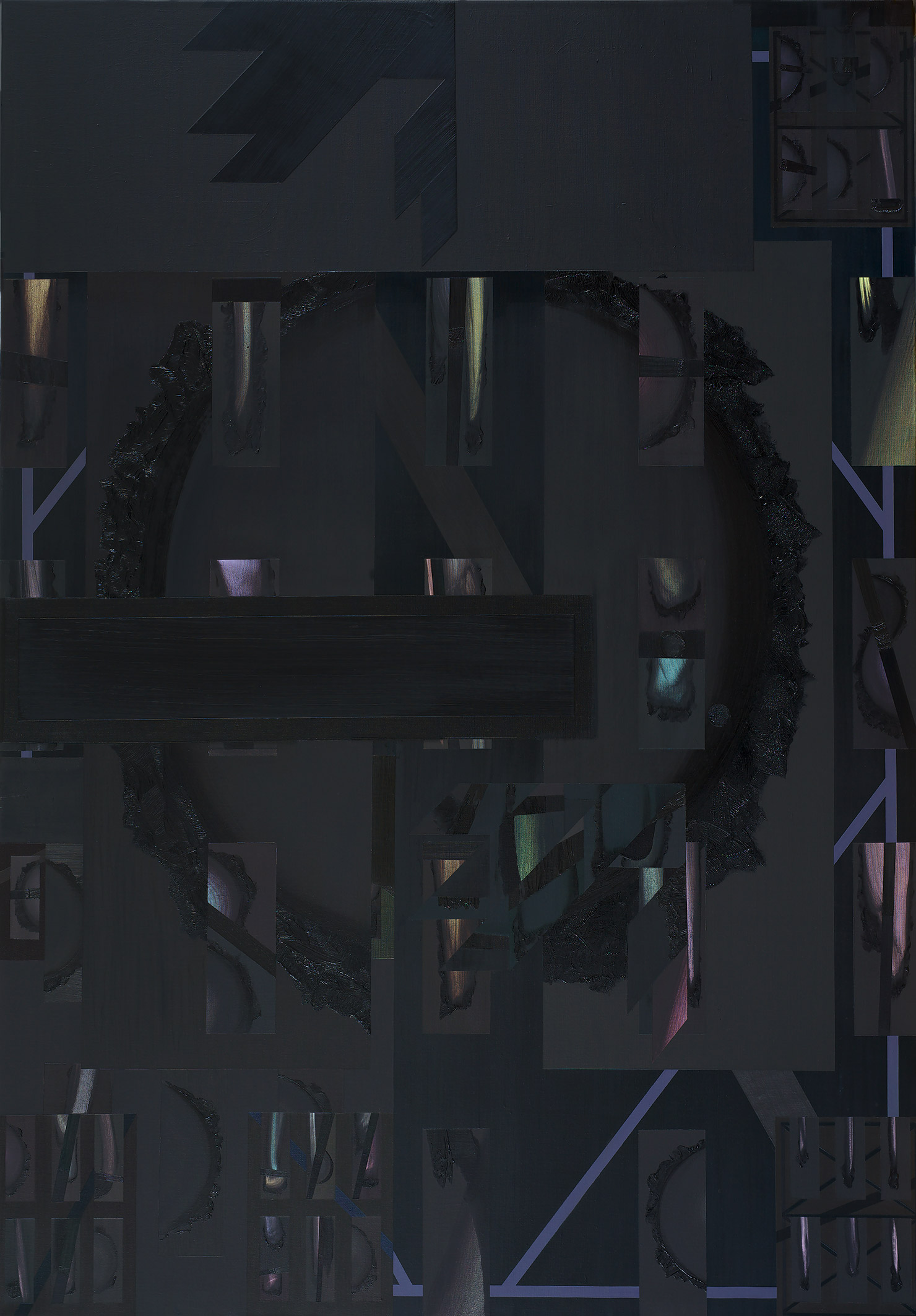

Klaus Merkel, 21.11.02 Ruck, 2024, Oil on canvas, 230 x 160 cm
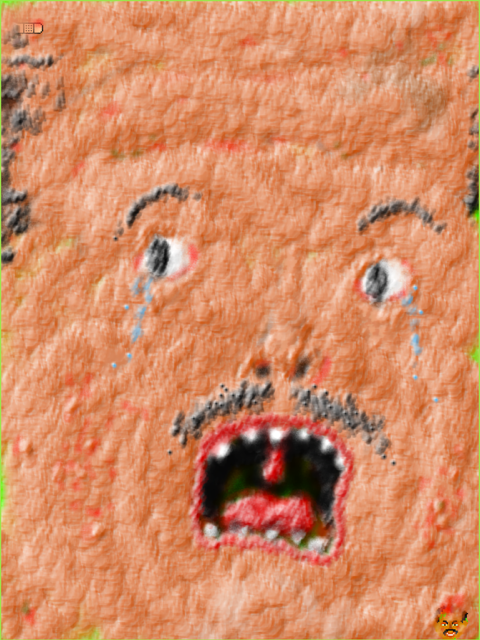
Waffles, kuujeb now for the future, 2026